Monday, June 24, 2019


Know Your Neighborhood: Christ Church Hospital, 306 - 308 Cherry St

Christ Church Hospital (Christ Church Hospital for Indigent Women) was founded by Dr John Kearsley in 1772 at 111 Arch St. The "Hospital" was not a hospital in the modern sense; it was a place to live for poor and widowed women of the church. In March, 1819 the hospital moved to a new, larger building at 306 - 308 Cherry St. The architect was William Strickland and the new building cost almost $19,000. It was (& is) 60 feet wide and 40 feet deep and had a rear wing that no longer stands. There were 24 rooms to accommodate 40 women.

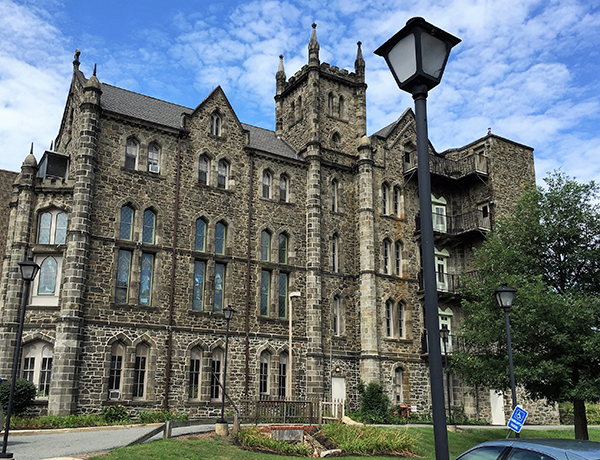
In the 1850's, a new, much larger, Christ Church Hospital was built at what is now 49th Street and Monument Avenue. The building was designed by architect John M. Gries (1827–62).  Gothic architectural details can be seen in this image, including narrow pointed arched windows, gable roofs, pinnacles, and spires.  In 1961, that hospital became Kearsley Rehab & Nursing Center—named for the hospital's founder.

The Church St building was converted into factory and warehouse space. In the 1910's the attic was turned into a full 4th story and in the 1980's the building was converted to apartments and office space.

It is an important example of late Federal institutional architecture. Although its tall gable roof and segmental arched dormers were replaced with a Second Empire roof in 1865, the rhythm and proportions of the façade as well as the Flemish bond brick reflect its Federal heritage.

ca 1900?


Today


Kearsley Rehabilitation and Nursing Center
Kearsley Rehab today

Sunday, June 16, 2019


Know Your Neighborhood: Old First Reformed Church  
Old First Reformed Church of the United Church of Christ (originally the German Reformed Church) is located at 151 N. 4th St (at Race St).

On September 21, 1727, the Rev. George Michael Weiss and 400 members of the German Reformed Church arrived in Philadelphia and organized in 1727 to became Philadelphia's Old First Reformed Church.  The first church building, a hexagonal structure, was completed in December 1747.

In 1774, the congregation replaced the hexagonal church with a new and larger building to accommodate the growing number of worshippers. During the American Revolution, the British Army that occupied Philadelphia used the church as a hospital and later as a stable.

In the 1830s, deterioration of the church building and growing traffic noise on Race Street caused the congregation to build a third church, which opened in 1837. This building had the same dimensions as the second church, but was rotated 180 degrees and set back farther from the street, in an effort to reduce the impact of street noise.


This third church is a restrained example of the Greek Revival style. It has Flemish bond brick, a symmetrical plan, pedimented front façade, marble watertable, and molded wood cornice, all key elements of the Greek Revival style. 

During the 2nd half of the nineteenth century, the area around the church became increasingly industrial and commercial, displacing many members who had lived nearby.  In 1882 the congregation moved to another location and sold the building to John Lucas & Co for use as a paint warehouse.

In 1966 the congregation (now located in West Phila.) voted to purchase the original 4th & Race St. site and adjacent lots from the Philadelphia Redevelopment Authority. The building, then vacant, had been in use as a paint warehouse for much of the early 20th century. It took four years to restore the church to it's former self.


                                                                    1774 church


May 1900


1966, under restoration


1972


today

Sunday, June 9, 2019


Know Your Neighborhood (& city):  For 12 years, Philadelphia held the title of “National Cleanest Town.”

Shocking but true. From 1947 to 1959, that title was bestowed upon Philly by the National Clean Up and Paint Up Bureau.

One look at the city’s streets today lets you know that distinction is no longer applicable. The trash and litter are so prevalent — albeit worse in some neighborhoods than others — that the moniker of “Philthadelphia” is commonly used. A good portion of fault can be traced to one simple fact:  Philadelphia is the only major city in the United States without a street sweeping program.
That wasn’t always the case, however. The idea that a city should mandate sanitation was conceived here and though Philadelphia wasn’t the first to implement organized municipal street cleaning, the city did have it for decades.
What happened?
Philadelphia modeled its first Street Cleaning Bureau after New York, which established the nation's first municipal street cleaning department in 1890. Unlike NYC, however, Philly’s street cleaners were hired by independent contractors, many of whom were also political bosses in Philadelphia’s Republican Party machine.

By 1900, Philadelphia had a population of over a million, and the sheer amount of waste generated demanded new kinds of services.

At that time horses were the main source of transport over ground and tons of horse manure accumulated on streets around the city. Across the country, a women-led movement for better public health led to multiple “sanitation parades” (1st photo) across the U.S. Though it was considered inappropriate for women to be involved in politics in this era, trash was considered an “extension of the household,” — like temperance and the prevention of cruelty to children and animals — so it was an acceptable issue for women to get involved.

The public activism and organizing of women in Philadelphia led to the city holding clean up weeks for more than 50 years and the honor of "national cleanest town" for 12 years straight.
In 1922, the city established the Department of Public Works, which oversaw the Street Cleaning Bureau, employing about 5,000 street cleaners, trash cart drivers and laborers.

Philadelphia's Cleanup Week in 1913 was the largest effort in the nation.  In 1914, 500 vacant lots were cleared and 140,000 cubic feet of rubbish was collected citywide.

In 1938, the city developed the Clean Block Program. Program participants were identified as “Block Captains,” who were responsible for encouraging residents of their designated block to maintain beautification and sanitation efforts (6th photo). The Philadelphia Streets Department was formed in 1952, with outreach efforts to teaching residents the proper ways to put trash out on the curb and reminding people to use public trash cans.

Street sweeping and other city cleanliness initiatives and services began to disappear by the 1970s. By the early 2000s, the Streets Department had gotten rid of a street sweeping unit. Complaints from residents not wanting to move their parked cars to alternate locations during street sweeping days combined with budget cuts ended street cleaning.

Thus we have Philthadelphia (or “Filthydelphia”), though the nickname may date to the 1930s. Only recently has there been talk street cleaning returning via pilot programs that would not require moving cars.


1914


1914 - street squeege


1917 mechanical street sweeper


1918 PTC sprinkler car


Wilshire power sweepers are tested 
out by city workers to clean Broad Street on May 25, 1949.


"cleaning down the block"


Monday, June 3, 2019


Know Your Neighborhood: Elfreth's Alley  

Elfreth’s Alley maintains the claim of being the oldest residential street in the United States. (Others with the same claim include Aviles Street in St. Augustine and Historic Huguenot Street in New Paltz, New York).  It dates back to 1702 when two blacksmiths (Arthur Wells and John Gilbert) surrendered portions of their land in order to create an alleyway that led to the river. The word "alley" once carried the flavor of a polite residential section.

The street, named after silversmith Jeremiah Elfreth who is said to have commissioned and developed it, was not a part of the original blueprint for Philadelphia.  Among the alley's early residents were tradesmen and their families, including shipwrights, silver and pewter smiths, glassblowers, and furniture builders.  Many of them stayed here only a year or two, although others lived out their lives on the alley.  In the 1770s, one-third of the households were headed by women.

With no contractor’s blueprints guiding them to a patterned uniformity, the alley grew as each colonist built his home according to his taste, and subject to his needs. The two oldest surviving dwellings on the alley are #'s 120 and 122 on the south side. According to a 1975 National Park Service document, Benjamin Franklin frequently visited House 122 to see William Maugridge, a tenant from 1728 to 1731 and one of the original members of the Junto, a club Franklin founded to discuss social issues and philosophy with his compatriots. Other well-known residents of the Alley included Betsy Ross; Dolly Madison, the wife of the fourth president of the United States, James Madison; and Stephen Girard, one of the wealthiest men in the 1800s.

Cabinetmaker and silversmith Daniel Trotter, pewterer William Will, and silversmith Philip Syng all resided on the sixfoot wide street. Syng was one of the most accomplished smiths in the colonies. In 1752, he fabricated the silver inkstand for the Assembly that was later used during the signing
of the Declaration of Independence.
Also, in 1770, Hannah Meyer married Reverend
John Peter Gabriel Muhlenberg, the “fighting parson” of Revolutionary War fame, at 119
Elfreth’s Alley.

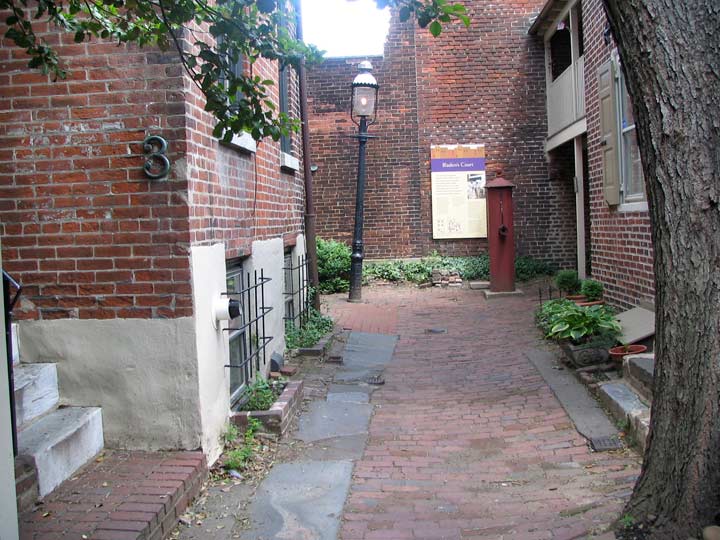
Three-quarters of the way down the alley (heading east) there is a very tiny side walkway to a small courtyard known as Bladen’s Court (last photo). This was created around 1750 by two neighbors who wanted access to their backyards. The men, who were brothers-in-law, ended up on opposite sides during the American Revolution. William Rush sided with the patriots, and Abraham Carlisle with the British. Carlisle ended up being hanged in 1778 for collaborating with the British during their occupation of the City. (The courtyard is named after a biscuit maker named William Bladen who lived there years later).

In the late 19th & early 20th centuries, the area surrounding the street became more industrial. Successive waves of immigrants, lured by the nearby jobs, moved onto the street. In 1900, the neighborhood was overwhelmingly Irish.

Preservation efforts for Elfreth’s Alley began in 1934. That was the year that the Elfreth’s Alley Association was founded. At that time, the City of Philadelphia had rebranded Elfreth’s Alley as the 100 block of Cherry Street and it was set to be destroyed. Not only did the organization save the street, but they were also able to turn the 100 block of Cherry Street back into Elfreth’s Alley.  The current Elfreth’s Alley houses were built between 1728 and 1836.


1910


                                     1940's


                                                                      Today


Bladen's court


Saturday, June 1, 2019


Know Your Neighborhood: Before the Wyndham on 4th St.....

The Merchants' Hotel, 40 - 50 N 4th St., was built in 1837 by Philadelphia architect William Strickland for a group of business men who felt the need of providing "up-to-date quarters" in the business district for visiting customers. For a long period it was considered one of the best hotels of its class in the country.  It was said the hotel could house up to 500 guests. The Merchant's Hotel was visited by the Presidents Van Buren, Pierce, and Buchanan (who also used the hotel as his presidential campaign headquarters in 1856).
With the shifting of trade to other parts of the city and the erection of the other more elaborate hotels, the Merchants became a less desirable place to stay. It ceased to be profitable and was converted for manufacturing and mercantile purposes.
During the night of February 9, 1966 the Merchants' Hotel (by this time used as a warehouse and for office space) was totally destroyed by fire.
The Wyndham Hotel currently sits on the site of the old hotel.


mid 19th century drawing


1910


                           in the 1960's


1960's


N side in the 60's


1977 Holiday Inn


today

Wednesday, May 15, 2019


FOCUS: Philadelphia; 'Old City' Stirring With Life  

THE Chocolate Works looms, large and Victorian, on one corner of the Philadelphia neighborhood known as Old City. On another corner sits Smythe's Stores with a handsome, cast-iron facade. Still another block features the Castings, a collection of industrial buildings dating from the 1700's that until recently was a foundry.
Block after block of the historic community along the Delaware River contains recently rehabilitated warehouses and factories.
In the last five years, more than 900 rental apartments have been carved out of former commercial structures, creating in the process an almost entirely new residential neighborhood.
For decades, the only residential area of Old City was Elfreth's Alley, the oldest continually inhabitated street in the United States. In 1970 the census found 80 residents of Old City. By 1980 the figure had increased to 300 and it is now put at close to 2,200.
The situation in Philadelphia is far from unique. Stimulated by tax breaks, hundreds of companies across the country have redeveloped 11,700 historic buildings since 1982, according to statistics from the National Trust for Historic Preservation. Altogether, the total investment in historic properties has been $8.8 billion.
Continue reading the main story
But Philadelphia has perhaps enjoyed the most concentrated burst of such development. Hundreds of buildings have been rejuvenated - many of them in Old City.
In the 1970's, Old City ''was an interesting and viable neighborhood,'' said William A. Kingsley, president of the Old City Civic Association. ''It was mostly wholesale, with some small manufacturing.'' Today, the area has a new element. ''Talk about yuppiedom,'' Mr. Kingsley said. ''In a survey we did of Old City residents, we found that more than 50 percent of the people had postgraduate degrees, the median age for men was 36 and for women, 33. Half of the household incomes were above $50,000.''
Although some developers talk of a soften-ing of the market for high-priced rental apartments - charges are approaching $1 a square foot per month, steep by Philadelphia standards - it appears that building activity in Old City is as furious as ever.
Construction crews are finishing the 135-unit Chocolate Works at 231 North Third Street and the 165-apartment Bridgeview at 315 New Street, two projects of Historic Landmarks for Living, a Philadelphia-based company and the largest historic rehabilitation company in the country.
The Castings, a 61-apartment building being developed by the American Classic Development Company on Quarry Street, is scheduled for opening late this fall. And the Devoe Group, another local company, has about 75 new apartments, including the Smythe Stores at Front and Arch Streets.
Old City, which extends from Race to Walnut Streets and from the Delaware River to Fifth Street, once was Philadelphia's center.
In the 1800's, however, businesses such as banks and retail stores and the residential population began to move west. At this point, Old City became a district of warehouses and light-manufacturing plants, with streets filled with four- and five-story buildings.
Planners say Old City never seriously suffered the heavy urban blight that rolled through many of the country's manufacturing districts. ''There were not many vacant properties,'' said Warren E. Huff, the Center City planner for the Philadelphia Planning Commission. ''But they were certainly underused.'' Interest began to focus on Old City as a possible residential area in the early 1970's. Artists seeking large and cheap living and working spaces found the old warehouse buildings perfect. Rents then were about 40 cents a square foot per month, or about $300.
By 1975, the city Planning Commission had studied Old City, ''looking at the potential of almost each and every building,'' Mr. Huff said.
Soon people like Stephen E. Solms, a developer who is the chairman and founder of Historic Landmarks for Living, ''started walking around the streets down there.''
''I thought, 'This is like SoHo,' '' said Mr. Solms, whose company now operates in seven states. ''This reminds me of New York.''
At the same time, the Federal Government instituted the Investment Tax Credit, which provided for accelerated depreciation on historically certified structures that were restored. In 1981, the Government strengthened the legislation, providing 25 percent tax credits in addition to the accelerated depreciation. In doing so it created a historic rehabilitation industry.
Although the rehabilitators of historic properties have suffered through almost three years of uncertainty about the status of their tax credits, as the Reagan Administration and Congress have debated new tax legislation, analysts say it appears as though the credits have been preserved.
IN 1982, Historic Landmarks started its first large project, the 97-unit Wireworks.
''It proved to be a major stimulus to development in Old City,'' said Carl E. Dranoff, president of Historic Landmarks. ''It brought in critical mass.''
Since then, Historic Landmarks has developed nine buildings in Old City, including the complex called Bank Street Court at 24-26 South Bank Street. Many others followed.
One, the Devoe Group, headed by Harry Devoe, has developed three properties in Old City. ''Mr. Devoe came in after Historic Landmarks and they've proven to be his biggest competitors,'' said Cynthia O. Hillsley, the vice president of the Devoe Group.
Florence Rosen, president of American Classic Development Company, said she did her first Old City building, the Chocolate Factory, in 1983. She said she was attracted to the area ''because it is always different.''
''There are new types of buildings,'' she said. ''History comes alive for you.''
While the area still has that excitement, some developers are beginning to talk of a slowdown in the rental market and in the development potential of Old City. The number of buildings suitable for large-scale restoration has declined dramatically, Mr. Dranoff of Historic Landmarks said.
And Mrs. Hillsley of the Devoe Group said that while the rental market ''will not dry up,'' the developers in Old City have to be aware of the ''decline in the yuppie population that started about five years ago.''
''The prospective residents are getting street smart,'' she continued. ''They want to know 'what can you do for me?' ''

Image may contain: sky and outdoor
Smythe Stores   100 block Arch St


The Castings 140 N Bread St


Know Your Neighborhood: Bridgeview Condominiums   
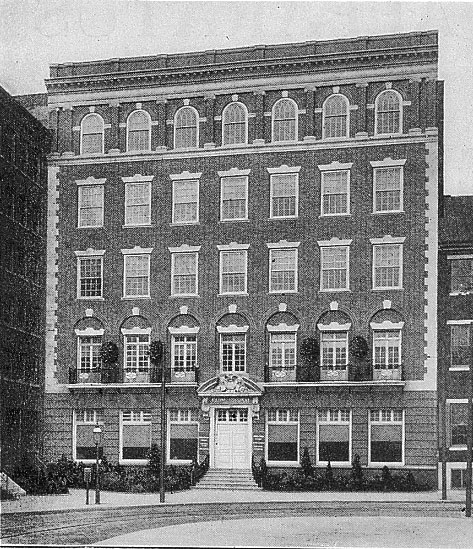
Arthur H. Thomas Scientific started in 1900 at the Freeman building at 12th & Walnut Streets in Philadelphia. During the early years, much of it's business was sales of Bausch & Lomb products and duty free imports from Europe. The company moved to West Washington Square in 1912 (1st photo), where they published their catalog that became the "bible" of the scientific industry.
In 1956, the company moved to 3rd & Vine Streets, on land once owned by the father of Betsy Ross. The new headquarters building had been the headquarters, warehouse and leather factory of England, Walton & Co., built in sections between 1913 & 1928. (2nd & 3rd photos))
Previously on that site, stood Francis Perot's Sons Malting Co.(4th & 5th photo)  One of Philadelphia's earliest breweries, Francis Perot's Sons Malting Co., was established on Front Street near the Delaware River in 1687 by Anthony Morris, who originally came over on the "Welcome" with William Penn.  Morris served as Philadelphia's 2nd mayor and later as a supreme judge of the Commonwealth of Pennsylvania.  The brewery remained in the Morris family's hands until the 1820s, when it was turned over to Francis Perot. Perot went into a partnership with his brother, William, and in 1850, the Perots quit brewing altogether and focused solely on malting, the process of turning barley seed into malt, one of the primary components of beer. The company remained in Philadelphia until 1907, when the Perots moved the business to Buffalo, N.Y.
In 1983 Arthur H Thomas Scientific formally changed the name to Thomas Scientific, and in 1984, the company moved to a new corporate headquarters in Swedesboro, NJ.  The building at 3rd and Vine was converted to an apartment building by Historic Landmarks for Living in the late 1980’s, and later converted to condos. (6th photo)


Arthur H Thomas Washington Square building (now the Farm Journal Bldg.)


1910 map


1917 ad


Bridgeview today